
The lushest-looking artificial grass isn’t always the best fit for your outdoor space. If you’re working out how to choose artificial grass, start with how you’ll use it, then compare how it looks and feels. A lawn for children, pets or regular foot traffic may need different qualities from one that’s mainly there to tidy up a quiet courtyard.
It’s easy to get bogged down in specifications when every option promises a convincing finish. Look beyond colour and appearance: texture, pile height, density and drainage can all affect how the grass feels and performs day to day.
This guide breaks the decision into practical questions. You’ll learn what to look for in appearance and feel, how to weigh up pets, children and everyday wear, and what to note before requesting an installation quote. Use the steps to compare options against your space and routines, rather than relying on a quick glance or a single specification.
Key Takeaways
- When deciding how to choose artificial grass, begin with what your yard needs to do, from family play to creating a neat front lawn.
- Compare pile height, density and blade shape to understand how different options may look and feel underfoot.
- Weigh softness, resilience and ease of cleaning separately when considering pets, children and entertaining.
- Inspect samples in daylight, both close up and from the distance you’d usually view your lawn.
- Once you’ve set your priorities, INSTATNT TURF can tailor an artificial grass installation package to your outdoor space.
How to choose artificial grass: start with what your yard needs
There’s no single artificial grass that suits every yard. A surface for quiet afternoons has different demands from one used for backyard cricket, family gatherings or pets racing through the garden. The right option depends on how you plan to use the space.
Start by naming the lawn’s main job. Is it somewhere to relax, an area for entertaining, a play space for children, a pet-friendly patch or a tidy front yard? If it needs to serve several purposes, write them all down and decide which matters most. This use-first approach makes how to choose artificial grass simpler: compare each option with your household’s real routines instead of searching for one universal “best” lawn.
If you’re new to the material, this overview of understanding artificial turf covers its construction, uses and general advantages and disadvantages. When choosing, focus on what your own outdoor area needs to handle.
Match artificial grass to your household
Think about how often people will cross the lawn and what they’ll do there. Regular foot traffic, children’s play and frequently moved outdoor furniture can make resilience a higher priority. A small decorative patch may see little use, so appearance could matter more than wear. These are qualities to compare, not guarantees that one type will suit every yard.
Picture an ordinary week: children playing, a dog using the yard, chairs being moved for a barbecue or a quiet spot to sit with a cuppa. The more jobs the lawn has, the more useful it is to consider comfort, resilience and ease of cleaning as separate needs.
Set priorities before comparing samples
Rank appearance, softness, resilience and upkeep from most important to least. Separate must-haves from preferences. For example, a comfortable surface might be essential for a family play area, while a particular shade of green could be a preference. A regularly used lawn may call for a different balance from a small feature area that’s mostly viewed from a window.
Make a short list before looking at samples:
- Use: relaxing, entertaining, play, pets or presentation.
- Must-haves: the qualities you don’t want to compromise on.
- Preferences: details you’d like, but could trade off.
- Site constraints: note shaded areas, the shape of the space and where furniture or paths sit.
Shade and layout are easy to overlook when you’re focused on the grass itself. A narrow strip beside a path has different practical demands from a broad, open lawn. Note these details so you can compare products against the space you actually have.
Keep your list handy as you review construction details and samples. It gives each specification a purpose: ask whether it supports your priorities instead of judging it in isolation.
Artificial grass construction explained: compare pile, density and texture
Once you know what the lawn needs to do, product specifications become easier to interpret. They’re not a scorecard where the biggest number automatically means the best choice. Each detail describes a different part of the surface, so compare the information with the look and feel you want in your yard.
Pile height describes how long the visible blades are; density describes how closely those blades are packed. Keep that distinction in mind as you compare options. Along with blade shape, colour and backing, these features help explain why two samples can look and feel different, even if their descriptions sound similar.
What pile height and density tell you
Pile height is the length of the visible grass blades. Shorter blades may give a neater, closely trimmed look, while longer blades can create a fuller appearance and a different feel underfoot. Neither is automatically right for every yard. Consider the look you prefer and how the surface will be used.
Density matters alongside height. A taller pile isn’t necessarily fuller, and a density figure on its own doesn’t tell you how comfortable the grass will feel. If specifications are provided, compare like with like: pile height against pile height, and density against density. Then handle the samples to see how those figures translate into a surface you can picture in your space.
Compare colour, blade shape and texture
Colour can look different under indoor lighting and outdoors, so inspect samples in daylight if you can. Look at each one close up, then step back to a typical viewing distance. A shade that seems convincing in your hand may appear too bright or uniform across the yard.
Blade shape and texture also affect the overall impression. Notice whether the blades look varied or very alike, and whether the surface feels soft, springy or firm to your touch. These checks won’t show exactly how a whole lawn will look, but they give you useful points of comparison.
Try this simple check before settling on a favourite:
- Place the sample beside your home’s exterior, paving or garden edging.
- View it in daylight from close up and from where you’d usually see the lawn.
- Feel the blades, then compare their length and density with another sample.
- Read the supplied specifications and compare equivalent details across options.
Look at the backing as part of the product’s construction, too. It’s the base that holds the grass blades in place, and its details may differ between products. One backing description won’t tell you everything about the finished lawn. Consider the stated specifications as a whole, alongside the sample’s look and feel.
When you’re weighing up options for a planned lawn, INSTATNT TURF designs and installs artificial grass with packages tailored to your outdoor space. Explore artificial grass installation as a practical next step once you’ve narrowed down the details that matter.
Which artificial grass suits pets, children and everyday entertaining?
A lawn used by the whole household has to balance different needs. A surface that looks tidy for guests may also need to feel comfortable for play, handle regular use and be practical to clean. Let intended use guide which product qualities matter, rather than expecting one option to excel at everything.
Use this comparison to decide what to pay attention to. These are priorities to weigh, not promises about how a particular product will perform.
| Household use | Priorities to compare |
|---|---|
| Pets | Ease of cleaning, resilience and product details suited to how your pet uses the yard |
| Children | Feel underfoot, comfort for play and how the surface may handle frequent activity |
| Entertaining | Appearance, resilience around furniture and how practical the area is to use |
| Mixed household | A workable balance of comfort, upkeep and regular-use needs |
Choosing grass for pets and children
Think through a normal day, not just the ideal use. Will children run, sit or play on the lawn? Does a pet spend time there, and how often might the surface need cleaning? These questions help you compare comfort, resilience and ease of cleaning as separate qualities. Softness alone doesn’t tell you how a lawn may stand up to regular play, and a resilient surface isn’t automatically the easiest to clean.
Pet suitability depends on the complete product and how the space is used. Read the product information in light of your household’s routines rather than assuming artificial grass is automatically safer or cleaner for every family. If the yard serves both pets and children, list the needs of each before deciding what matters most.
Consider heat and entertaining needs
Artificial grass can become warm in direct sun. Surface temperature varies with conditions and product, so don’t assume a sample will feel the same in every part of the yard or at every time of day. Note which areas get the most sun, where shade falls and when your household is most likely to use the space.
For a spot mainly used for evening get-togethers, appearance and resilience around chairs may lead your comparison. If children or pets use a sunny area during the day, comfort and exposure deserve more attention. Think about where people will sit, move furniture or gather, then compare options against those practical details.
If the lawn has several jobs, rank them and decide which qualities are essential and which are preferences. This makes how to choose artificial grass more straightforward, while keeping everyday comfort, cleaning and entertaining in view.
How to compare artificial grass samples before you decide
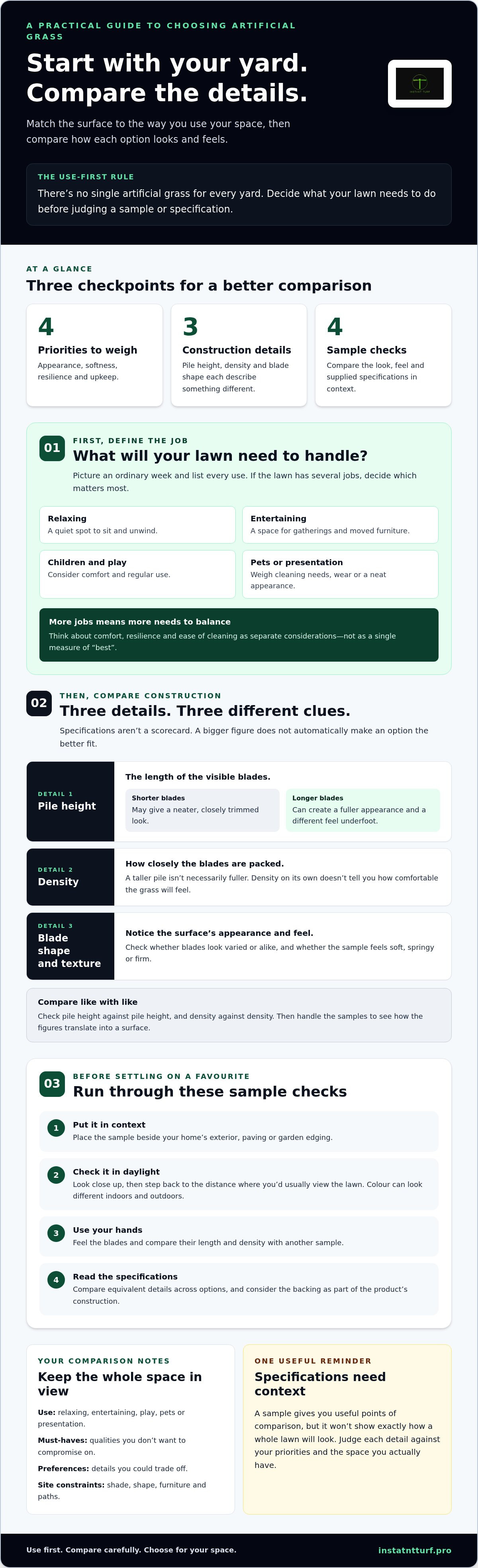
A sample is useful, but it’s only one part of the decision. It lets you compare the surface in your own yard, while the finished lawn will cover a larger area alongside paths, garden beds and the home. Use a repeatable process so colour or texture doesn’t distract from the priorities you’ve already set. That’s a practical way to approach how to choose artificial grass without relying on a quick glance.
Work through these steps in order:
- Revisit your priorities. Keep your main use and must-haves in mind, whether that’s appearance, softness, resilience or ease of upkeep.
- Compare the samples. Look at colour, blade shape, texture and density in daylight. View each sample close up, then from the standing distance you’d usually see the lawn.
- Check the specifications. Read the product information and compare equivalent details where they’re supplied. Note any care guidance, too.
- Assess the whole project. Consider the area’s exposure, shape, existing surface and how the lawn will sit beside nearby features.
Use a repeatable sample-checking process
Take samples outside and view them in more than one spot if the area gets changing light. Place each beside paving, garden edging or nearby planting to see how its colour and texture sit with those surroundings. A small piece can’t show the look of a whole lawn, so treat it as a comparison tool, not a perfect preview. Jot down what stands out and any compromise you’d be making.
Check the details beyond appearance
Appearance won’t tell you everything. Review the supplied specifications and care guidance, then consider how the product relates to your yard’s intended use, sun exposure and underlying surface. A sample can’t show how the whole project will come together, so keep these practical details beside your visual notes. This makes it easier to compare options on more than first impressions.
Include drainage and ground preparation in your project plan. The sample itself won’t show how the site should be prepared or how water will be managed across the finished area. Note existing slopes, low spots or surfaces that may affect planning, without assuming a particular product detail guarantees a result. The synthetic grass installation homeowner guide offers broader guidance on planning the work.
Before deciding, keep your notes together: the features you liked, the specifications you compared and the practical questions raised by the site. This gives the installation discussion a useful starting point. Plan your artificial grass installation with INSTATNT TURF, whose flexible turf packages can be tailored to your outdoor space.
Choose artificial grass and plan your installation with confidence
You’ve narrowed the choice by considering how the lawn will be used, which qualities matter most, the product details and how samples look in your outdoor space. Now bring those points together. A short project brief makes it easier to explain what you want and gives the installation team a practical starting point for shaping a suitable package.
Turn your shortlist into a clear project brief
Write down the lawn’s main use, your preferred look and the household needs it must accommodate. Include the product details you’ve compared and what you noticed when viewing samples outside. If you’re choosing between two options, note the trade-off, such as preferring one sample’s colour but another’s feel.
Add useful site context, too. Mention access to the area, its shape and nearby outdoor features such as paving, garden beds or existing furniture. You don’t need to work out every installation detail yourself. A clear picture of the space and how you use it helps the team tailor an artificial grass package to your project.
Know what to expect from the next step
INSTATNT TURF designs and installs artificial grass, with flexible turf packages tailored to your outdoor space. Request a free fixed quote with no obligation or upsells, then review the project details without pressure. A lifetime workmanship guarantee provides added reassurance about the installation work.
Most lawns are installed within one to two days after approval, and same-week availability is offered. These details can help you plan. Your project brief also keeps the discussion focused on the space, the finish you want and the way your household will use it.
Before requesting a quote, gather your notes in one place:
- Use: how the lawn needs to work day to day.
- Priorities: the qualities you consider essential, plus any preferences.
- Product details: the specifications and sample impressions that shaped your shortlist.
- Site context: access, layout and features around the proposed lawn.
That’s enough to take the next step with a clearer idea of what you need. If you’re ready to discuss an artificial grass installation, request a free, no-obligation fixed quote. There’s no pressure to proceed, just a straightforward way to turn your choices into a project plan.
Take the next step towards a lawn that fits
A good choice isn’t about finding a sample that looks impressive on its own. It’s about feeling confident that the finished space will suit your household and the way you want to use your yard. Keep your shortlist and notes handy. They’ll help turn your thinking about how to choose artificial grass into a clear starting point for planning the installation.
INSTATNT TURF designs and installs artificial grass, with flexible packages tailored to your outdoor space. Request a free, no-obligation fixed quote, with no upsells, and have the reassurance of a lifetime workmanship guarantee. Most lawns are installed within one to two days after approval.
When you’re ready to discuss your project, request a free, no-obligation fixed quote. It’s a straightforward next step, with no pressure to proceed. A considered choice now can help make your outdoor space more useful and welcoming for everyday life.
Frequently Asked Questions
How do I choose artificial grass that looks realistic?
To work out how to choose artificial grass that looks realistic in your yard, judge the sample where it will sit, not from a product photo alone. Notice whether its colour and texture suit the home and nearby garden features. If you’re comparing options, view them together so differences are easier to spot. A natural-looking finish is only one part of the decision; consider how you’ll use the area, too.
Is thicker artificial grass always better?
No. “Thicker” can refer to different qualities, so clarify whether a product description means longer blades or denser coverage. A taller pile may create a fuller-looking surface, but it doesn’t automatically mean the grass is more densely packed or right for your needs. Compare the specifications provided and consider the finished look you prefer. For a small area seen mainly from indoors, appearance may matter more than feel underfoot.
Does artificial grass get hot in the Australian sun?
Yes, artificial grass can become warm in direct sunlight, though the surface temperature depends on the product and conditions. Consider the area’s sun exposure and the times your household usually uses it. A lawn used for afternoon play has different comfort considerations from one mainly seen from the kitchen window. Shade and how the surface feels are useful parts of your decision, but don’t assume a particular product will stay cool.
Is artificial grass suitable for dogs and other pets?
It can suit some pet households, but there isn’t one option that works identically for every animal or yard. Consider where your pet spends time, how often the area will be used and what cleaning routine you can manage. Read product information for details relevant to those needs. For a small dog that mostly crosses the lawn, your priorities may differ from those for a space where several pets spend extended time outdoors.
Can artificial grass be installed over concrete?
Possibly, but it depends on the existing surface and the project. A level, sound concrete area presents different planning questions from one with cracks, uneven sections or drainage concerns. Include the surface condition, access and the edges where grass would meet paving or walls in your project brief. The grass choice alone can’t determine whether installation over concrete is suitable. Consider the whole site before settling on that approach.
How long does artificial grass last?
There’s no single lifespan that applies to every artificial lawn. Product construction, exposure, how often it’s used and how it’s cared for can all affect how it looks over time. Look for product-specific information rather than relying on a broad lifespan claim. Also distinguish the expected performance of the grass itself from terms covering installation workmanship; they refer to different parts of the project.
Is artificial grass environmentally friendly?
There isn’t a simple yes-or-no answer. The overall impact depends on the materials, how the product is made and used, and what happens when it reaches the end of its life. Artificial grass also changes a yard’s upkeep compared with natural grass, so the trade-offs depend on what matters to your household. Review product-specific material and disposal information, then weigh it against your priorities for water use and maintenance.

